29 September 2025
Loading



Velmor Teknoloji
13 August 2026
For a Charge Point Operator, the central charging management platform is one of the most critical layers of the entire operation. Station availability, charging sessions, tariffs, users, payments, reporting, remote commands and third-party integrations all depend on the central system.
Therefore, when a CPO becomes dissatisfied with its existing software, the main question is not simply "Is there a better charging management platform?"
"How can we change our CPO software without putting our live charging network at risk?"
Limited reporting, high licensing costs, insufficient technical support, performance issues, difficult integrations and slow feature development can all lead an operator to consider a new CSMS.
Connections between physical charging stations and the current backend must be migrated. Different manufacturers, models and firmware versions may require different migration methods.
Locations, stations, connectors, tariffs, organizational structures, permissions and business rules need to be prepared in the new platform.
Customer accounts, RFID cards, user groups, subscriptions and wallet structures may need to be transferred separately.
Payment providers, invoicing systems, roaming connections, APIs and other external services must be validated in the new environment.
A successful backend migration can still become an operational problem if drivers cannot log in, find stations, pay or start charging. Mobile application processes therefore need to be included in the migration plan.
Moving an entire charging network to a new CSMS in a single cutover can introduce unnecessary operational risk.
For this reason, CPO software replacement should be treated as a controlled migration project, not as a single technical switch.
When migrating to a platform such as ChargenOS, station definitions, organizational structures, permissions, tariffs, payment systems, reporting and integrations can be prepared before the live transition begins.
A small group representing different charger manufacturers and models can be migrated first. Charging operations, status notifications, meter values, payments and authorization flows should be verified during this stage.
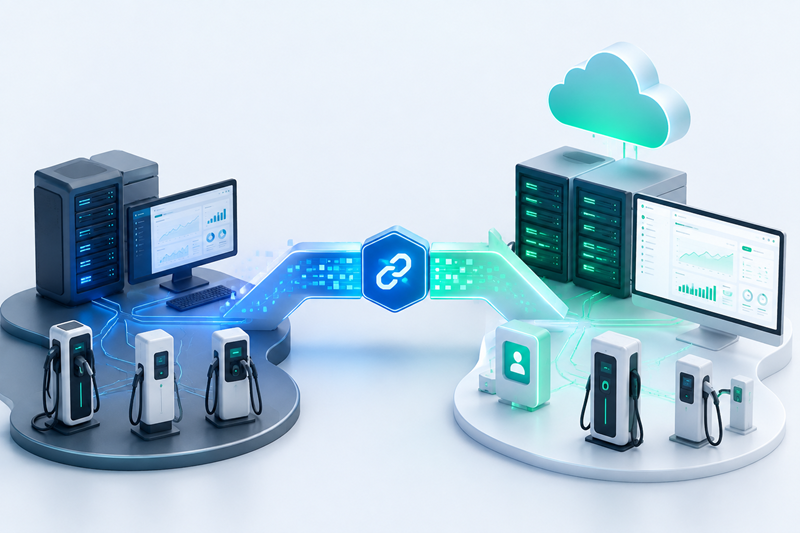
The ChargenOS OCPP Proxy approach can help separate charger connectivity from the final backend migration.
Chargers can first be connected to a controlled OCPP routing layer while traffic continues to be routed to the existing CPO platform. Once the new ChargenOS environment is ready, backend routing can be changed centrally.
For a detailed technical explanation, read OCPP Proxy for CPO Software Migration.
Charging history, users, RFID cards, tariffs, financial records, payment information and reporting datasets should be evaluated separately.
A strong migration plan describes not only how to move forward, but also how to return to the previous environment if an unexpected issue occurs.
ChargenOS, developed by Velmor Technology, is a centralized charging network management platform designed for CPO operations.
The objective is not simply to replace one dashboard with another. The existing charging infrastructure, integrations and operational requirements should first be evaluated and migrated through a controlled transition plan.
Yes. Charging networks can migrate between central management systems, particularly where open standards such as OCPP are used.
It depends on the migration architecture. With a staged migration model, the entire network does not necessarily need to be taken offline at the same time.
OCPP provides an important interoperability layer, but implementations may vary between manufacturers, models and firmware versions.
This depends on the data available from the existing platform and the migration capabilities of the new system.
An OCPP Proxy is a communication and routing layer between charging stations and a central charging management system.
No. Large networks can be migrated by manufacturer, model, location or operational group.
With a complete infrastructure inventory, compatibility testing, pilot migration, data planning, integration preparation and technologies such as OCPP Proxy, the transition to a new CPO platform can become significantly more manageable.
If you are considering changing your current CPO software, the first step should not be switching servers. It should be designing the right migration plan for your charging network.