29 September 2025
Loading



Velmor Teknoloji
26 October 2025
With the rise of Industry 4.0, digital transformation has expanded beyond software and cloud solutions — the physical world itself has become intelligent, responsive, and data-driven. At the heart of this revolution lie two complementary forces: the Internet of Things (IoT) and automation.
IoT connects millions of devices, machines, and sensors into a unified network, while automation converts the resulting data into meaningful actions. Together, they form a self-learning ecosystem that not only optimizes performance but also reduces human error, increases energy efficiency, and strengthens decision-making processes.
IoT (Internet of Things) refers to a vast network of interconnected devices that communicate and exchange data via the internet. These devices range from smart home appliances to industrial sensors and autonomous vehicles.
However, IoT’s impact extends far beyond consumer technology. It now drives efficiency and innovation in sectors such as manufacturing, energy, logistics, healthcare, and agriculture.
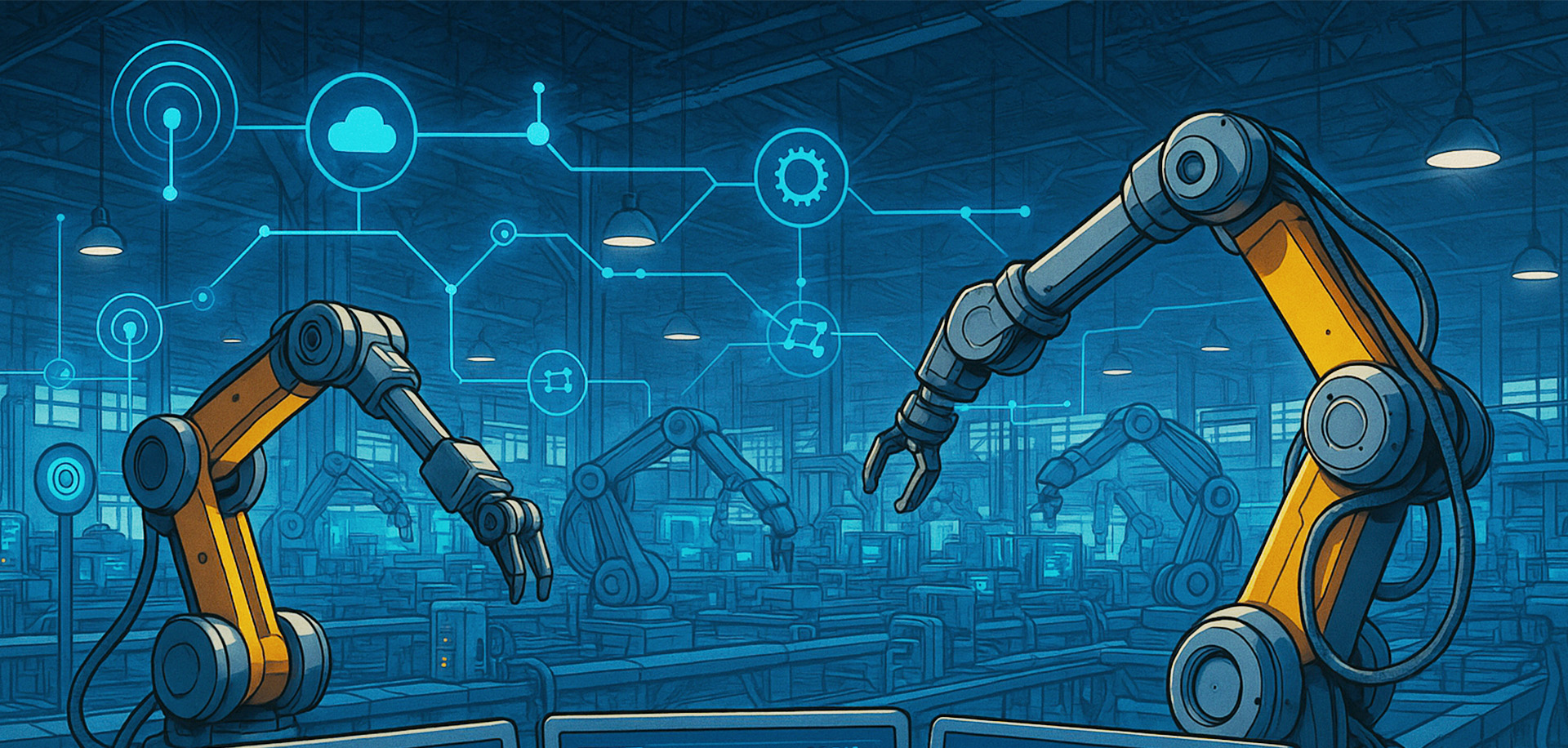
For example, in a smart factory, sensors monitor machine temperature, vibration, and energy consumption. The collected data allows the system to predict failures and perform preventive maintenance, reducing downtime and optimizing production.
Automation enables processes to run faster, safer, and more consistently with minimal human intervention. What began as mechanical automation during the first industrial revolution has evolved into AI-powered digital systems today.
Modern automation includes Robotic Process Automation (RPA), Machine Vision, and Industrial Control Systems such as SCADA, PLC, and DCS. These systems not only manage production lines but also optimize energy consumption, logistics, and quality control in real time.
In short, automation has become the nervous system of industrial operations, seamlessly integrating human expertise with machine precision.
When IoT and automation converge, they create data-driven and self-operating environments.
IoT devices collect real-time information, while automation systems analyze it and trigger appropriate actions.
For instance, in an intelligent energy management system, sensors measure demand, and automation algorithms balance the load, preventing energy waste.
Similarly, an electric vehicle charging platform — such as Velmor’s ChargenOS — can use IoT and automation to manage charging sessions, monitor power flow, and adjust pricing dynamically, ensuring seamless operations across an entire charging network.
The fusion of IoT and automation is redefining operations in nearly every sector:
Manufacturing: Smart factories track machine performance and optimize assembly lines with real-time analytics.
Energy: Smart grids balance generation and consumption, reducing carbon emissions and preventing outages.
Agriculture: IoT sensors measure soil moisture, weather, and crop health to optimize water and fertilizer use.
Logistics: Connected tracking systems monitor the entire supply chain, ensuring transparency and efficiency.
Healthcare: Remote monitoring devices collect patient data in real time, enabling early diagnosis and preventive care.
These use cases illustrate how IoT and automation together create a responsive and adaptive industrial ecosystem.
IoT generates a massive volume of raw data every second — but data alone has no value without insight. This is where AI and advanced analytics step in.
AI algorithms process IoT data to predict outcomes, detect anomalies, and automate responses. For instance, predictive maintenance powered by machine learning can detect subtle irregularities in machinery and prevent costly failures before they occur.
By combining automation with AI, organizations can accelerate real-time decision-making and continuously optimize their processes. In essence, AI turns IoT data into intelligence, while automation turns that intelligence into action.
Each connected device represents both opportunity and risk. As IoT networks expand, cybersecurity becomes a top concern.
Modern IoT environments employ Zero Trust architecture, end-to-end encryption, and multi-factor authentication to safeguard data.
At the same time, compliance with global standards such as GDPR, KVKK, and ISO 27001 ensures that sensitive data is stored and processed responsibly.
In this interconnected world, security must evolve from being reactive to proactive, adaptive, and embedded by design.
The coming decade will accelerate IoT’s evolution through Edge Computing, 5G networks, AI-driven automation, and Digital Twin technology.
Edge Computing processes data locally on the device, reducing latency and enhancing data privacy. 5G will allow billions of devices to exchange information in real time with unprecedented speed.
Meanwhile, Digital Twins — virtual replicas of physical systems — will simulate, analyze, and optimize performance before real-world deployment.
These innovations will make IoT networks faster, smarter, and more autonomous, marking the next phase of industrial intelligence.
IoT and automation are no longer optional — they are the foundation of competitive advantage.
Organizations that embrace these technologies gain real-time visibility, reduce costs, and unlock operational agility.
IoT data empowers leaders to make data-driven strategic decisions, while automation ensures those decisions are executed flawlessly.
The result is a more resilient, efficient, and future-ready organization that can adapt to changing market conditions instantly.
IoT and automation are the twin pillars of the digital era. The boundaries between humans, machines, and data are disappearing, replaced by intelligent networks that learn, adapt, and evolve.
Machines no longer just operate — they communicate, collaborate, and decide.
The winners of tomorrow will be the organizations that see digitalization not as a tool but as the core of their strategy.
The future of industry is one where connected intelligence drives progress, sustainability, and growth.